

How to Sell a Car With a Loan Still on It (2026 Guide)
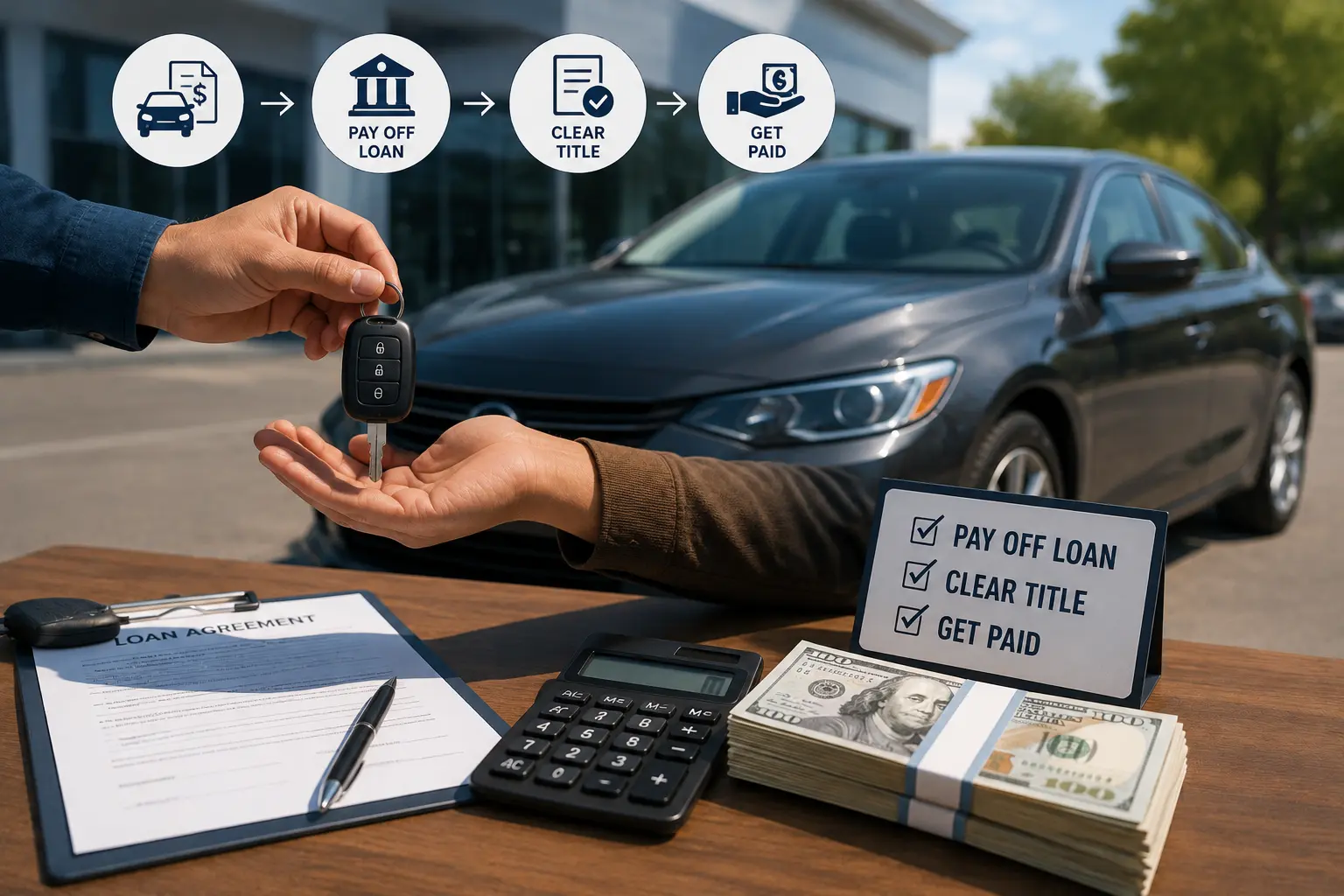
Who actually holds your car’s title while a lender’s name still sits on it? And if you sell before that loan is paid off, who gets the check first, you or the bank? Most owners in Fostoria, Findlay, and Tiffin find out the answer only after they’ve already accepted an offer, which is exactly backward.
The lienholder controls your title until the loan is paid off, full stop. That single fact changes the order of operations for selling a financed vehicle, and it’s why the payoff math has to happen before you shop offers, not after.
Key Takeaways
- Your lender holds the title (or the electronic lien record) until the loan balance hits zero, regardless of whose name is on the registration.
- Request a 10-day payoff quote before accepting any offer. Your last statement balance is not the payoff amount.
- Run the math first: appraised offer minus payoff equals what you walk away with, or what you still owe.
- Negative equity doesn’t block a sale. It just determines whether you pay the gap now or roll it forward.
- A direct buyer who pays your lienholder directly removes a step that private-party sales can’t avoid.
Who Actually Owns Your Car While You’re Still Paying On It
Your registration has your name on it. Your title, or the lien record behind it, does not, at least not entirely. In both Ohio and Michigan, a car with an open loan carries a lien, meaning the lender has a legal claim until the debt is cleared.
Ohio uses an Electronic Lien and Title (ELT) system through the Ohio BMV. That means no paper title exists in your hands at all while the loan is active. The record sits electronically with your lender, and it only releases to you once the payoff posts.
Michigan works a bit differently: the Secretary of State can issue a paper title showing the lienholder, or the lender holds it directly, depending on how the loan was set up.
Get the Real Number, Not the Statement Balance
This is the step owners skip most often, and it costs them.
- Call or log in to your lender and request a 10-day payoff quote, not your last statement balance.
- Understand that interest accrues daily, so your payoff amount rises slightly each day past the quote date.
- Confirm whether your lender charges a payoff fee or requires a certified check versus a wire.
- Ask directly who releases the lien, the lender or a third-party servicer, and how long that release takes to post with the state.
The Math You Need to Run Before You Sell a Car With a Loan
Selling a car with a loan comes down to one formula: offer amount minus payoff amount equals your proceeds. If that number is positive, you walk away with cash. If it’s negative, you owe the difference.
Here’s a worked example. Say you own a 2022 midsize SUV with a payoff of $14,500. A buyer values it at $16,200. Subtract the payoff from the offer and you walk away with $1,700, paid to you directly once the lienholder is satisfied.
Now flip it. If that same SUV had a payoff of $17,000 against a $16,200 offer, you’d owe $800 at closing. This is negative equity, and it’s more common than most sellers assume given how fast newer vehicles depreciate against loan terms. You have two real options:
- Pay the $800 difference out of pocket at signing to clear the lien.
- Roll the shortfall into a new vehicle loan if you’re buying your next car the same day.
Trade-in value and private-party value are not the same number, even against an identical payoff. A dealer trade-in typically nets lower because the dealer prices in resale risk and reconditioning cost. A direct cash buyer or private sale usually lands closer to true market value, which matters most when your payoff is high and you need every dollar of equity to clear it.
What Happens at Closing When a Lien Is Involved
Three paths exist for closing a sale on a financed vehicle, and they don’t handle the lien the same way.
- Private-party sale. The buyer has to send funds to your lender, sometimes to a bank they’ve never worked with, before the title clears. Many private buyers hesitate here. Wiring money to a stranger’s lender feels riskier than buying a car with a clean title in hand, and that hesitation often kills deals or forces a price cut.
- Dealer trade-in. The dealership pays off your loan as part of the transaction, but the payoff amount gets folded into your new purchase paperwork. You rarely see a clean breakdown of what you actually gave up in the trade.
- Direct buyer payoff. This is where a service built around Direct Car Purchasing changes the sequence. Sell with Reineke contacts your lender, confirms the exact 10-day payoff figure, and pays that amount straight to the bank. Whatever equity remains gets issued to you in person, the same day, at any of six locations across Ohio and Michigan.
This process isn’t limited to sedans. It applies the same way to Truck and SUV Purchasing, Van Purchasing, and even Powersports Vehicle Purchasing when a loan is attached. The lien mechanics don’t change based on vehicle type, only the appraisal inputs do.
Mistakes That Turn a Simple Payoff Into a Delay
Most payoff problems aren’t math errors. They’re sequencing errors, where a seller does step three before step one.
Skip these mistakes:
- Using your monthly statement balance instead of requesting a real 10-day payoff quote from your lender.
- Assuming a buyer’s check clears the same day the lien releases. It doesn’t. Some banks take one to three weeks to process and report the release to the Ohio BMV or Michigan Secretary of State.
- Getting an offer before running an Online Vehicle Valuation, which means negotiating without knowing your real number.
- Never confirming who files the lien release paperwork. In a private sale, that responsibility often falls back on you if the buyer’s bank drags its feet.
Pro tip: Ask your lender for their exact payoff processing window in writing before you close. A verbal “a few days” from a call center rep is not the same as a documented turnaround time, and that gap is where sellers get stuck holding liability on a car they no longer drive.
The Real Cost of Getting the Sequence Wrong
Selling a car with a loan isn’t complicated once you treat it as a math problem to solve first, not a paperwork issue to sort out later. Get your payoff quote, run it against a real offer, and know your number before you sign anything.
That’s the advantage of working with a buyer who handles the lienholder directly instead of routing the payoff through you.
Local, in-person purchasing across six locations in Ohio and Michigan means no wire transfers to a stranger’s bank and no waiting weeks to find out if a private buyer’s funds actually cleared.
Start with a free Online Vehicle Valuation, then Get Your Offer and see exactly what you’d walk away with once your payoff is covered.
Frequently Asked Questions
Can I sell my car if I still owe money on the loan?
Yes. Lenders allow this constantly, as long as the payoff amount gets satisfied at or before closing. The lien releases once the lender confirms full payment, then the title transfers to the new owner.
How do I find out my exact payoff amount?
Contact your lender directly and request a 10-day payoff quote, either by phone or through your online account. This differs from your monthly statement balance because it includes accrued daily interest through a specific date.
What happens if I owe more than my car is worth?
This is called negative equity, and it doesn’t prevent a sale. You either pay the difference out of pocket at closing or roll the shortfall into financing for your next vehicle.
Does Ohio’s electronic title system change how I sell a financed car?
Yes, slightly. Ohio’s ELT system means no physical title exists until the lien releases electronically, so your buyer or the buyer’s lender coordinates directly with your lienholder rather than handling a paper title exchange.
How long does a lien release take after payoff?
It varies by lender, but many take one to three weeks to process and report the release to the state. Always ask your lender for a written processing timeline before you close the sale.

Ready to sell your car?
8 places to bring a vehicle across 6 towns, or start it from your driveway with the plate and a few photos.
Would rather talk? 419-435-7741